
Villages along the Uttar Pradesh-Bihar border are on high alert following devastating flash floods in Nepal, with authorities monitoring the Gandak River for potential downstream surges and the NDRF deploying 20 teams for preparedness.

A senior Geological Survey of India official warns that the Himalayas are vulnerable to cascading disasters, where one high-altitude event can trigger a chain of destructive events downstream, as evidenced by Nepal's recent floods. He stresses the need for integrated monitoring using satellite data and ground investigations to identify high-risk areas and improve preparedness in the Indian Himalayas.

The weather office has warned that the prevailing monsoon conditions could trigger flash floods, landslides, waterlogging and a further rise in river levels across the Northeast.

Uttarakhand Chief Minister Pushkar Singh Dhami has directed officials to strengthen regular monitoring and safety measures for 13 identified 'sensitive' glacial lakes in the state, citing potential risks in hilly regions.

The National Disaster Response Force (NDRF) is closely monitoring the India-Nepal border regions in Bihar and Uttar Pradesh for any adverse impact from the devastating flash floods in Nepal. While no significant impact has been reported yet, 20 NDRF teams are deployed in the Indian states for potential relief operations. India has also sent humanitarian aid to Nepal and has additional NDRF teams on standby for deployment if requested.

The Gandak river's water level in Bihar is showing a receding trend, bringing relief to low-lying areas after flash floods in Nepal caused a surge. Despite a marginal rise due to late-night rainfall in Nepal, authorities are monitoring the situation closely, with no adverse impact on embankments reported.

Devastating flash floods in Nepal's Bhote Koshi River, triggered by a glacier or ice rock collapse, have resulted in 175 recovered bodies and hundreds missing, including tourists. India has promptly responded by providing 10 tons of humanitarian aid and medical supplies, with Prime Minister Narendra Modi conveying condolences and assuring full support to Nepal.

Parts of Bihar are facing a potential deluge as major rivers like the Ganga, Gandak, Kosi, and Burhi Gandak show rising water levels. This surge is attributed to devastating flash floods and continuous rainfall in neighbouring Nepal, prompting authorities to open barrage gates and place disaster response teams on standby.

Bihar and Uttar Pradesh are on high alert following devastating flash floods in Nepal's Gandak river system, prompting emergency measures including evacuations and continuous monitoring by central and state authorities.

Sikkim has identified 40 high-hazard glacial lakes, with 16 at the highest risk of catastrophic outbursts. Following a devastating GLOF in 2023, the state is developing India's first dedicated GLOF Risk Mitigation Protocol, using advanced monitoring and interdisciplinary approaches to protect downstream settlements and serve as a model for other Himalayan regions.

Eleven days after devastating floods triggered by an ice-rock avalanche, Nepal continues to grapple with a rising death toll of 1,344 and nearly 5,000 missing. Authorities face significant challenges in identifying the deceased, with many bodies severely damaged. DNA samples are being collected from relatives to aid identification, while the government mobilises relief and rehabilitation efforts. A fresh flood incident in Gorkha district also caused damage.

Heavy rainfall caused significant waterlogging in New Delhi, particularly near IGI Airport, just days before the BRICS Summit. The incident highlighted coordination issues among various city agencies, with PWD officials attributing some flooding to other departments, despite a recent review meeting by the Lieutenant Governor to ensure inter-agency synergy.

Nepal's former Forest and Environment Minister Madhav Prasad Chaulagain has expressed concern over the lack of timely information exchange with China ahead of the devastating floods, stating that the disaster's scale could lead to an 'unbelievable' rise in the death toll.

'The trigger for the flood was definitely natural, but the damage that it caused was human-made.'

Amid a significant split within the Trinamool Congress (TMC), two "dissident" MPs, June Maliah and Deepak Adhikari (Dev), along with an MLA, attended an administrative meeting chaired by West Bengal Chief Minister Suvendu Adhikari. This event follows a major rebellion within the TMC, where 20 Lok Sabha MPs reportedly declared support for the BJP-led NDA as a separate bloc.

The administration has been put on high alert following the India meteorological department's (IMD) forecast of extremely heavy rainfall across several districts of Gujarat in the next two days.

Mumbai experienced heavy overnight monsoon rains, with some areas receiving over 200 mm in 24 hours, leading to widespread waterlogging, traffic congestion, and disruptions in suburban train services, particularly on Central Railway lines due to a track cave-in.

Kerala Chief Minister V D Satheesan announced that the death toll from rain-related incidents has reached 15, with seven people still missing. He confirmed that the overall situation is under control, except for a few areas in Pathanamthitta, as the state intensifies rescue and relief operations. The CM detailed the deployment of rescue teams, functioning relief camps, and immediate compensation measures for victims and affected families, while also cautioning against rumours regarding dam water release.

The Delhi government is establishing a multidisciplinary committee to develop a regulatory framework for coaching institutes. This initiative follows recent tragedies, including the Saket building collapse and the Old Rajendra Nagar coaching centre incident, and aims to address issues like fee structures, student safety, infrastructure, and grievance redressal.

Maharashtra Chief Minister Devendra Fadnavis has warned of a possible cloudburst-like spell in Nashik on Tuesday and stated that the state machinery is on high alert, with heavy rains expected to continue until July 8. Citizens are urged to avoid unnecessary travel as authorities manage landslides, swollen rivers, and rescue operations.

Heavy monsoon rains have severely impacted Mumbai and its surrounding areas, leading to landslides, suspension of train services, and at least 13 fatalities over the past few days. The Mumbai-Pune Expressway was also shut due to a concrete pillar collapse and waterlogging.

An expert from the ICMR's National Institute of Virology addresses concerns about hantavirus cases detected on a cruise ship, stating there is no immediate public health threat to India and that the cases appear isolated.

A comprehensive risk assessment warns that Kishtwar district in Jammu and Kashmir faces a serious threat from glacial lake outburst floods (GLOFs), endangering lives, infrastructure, and the ecosystem. The report calls for immediate mitigation measures and long-term strategies to build resilience.

The Mumbai Metro Rail Corporation (MMRC) was forced to suspend the operation after flooding was reported at the underground Acharya Atre Chowk station.

Houses in low lying areas of Kerala were flooded in the heavy rains, while the accompanying strong winds uprooted trees, damaged homes and caused power disruptions, throwing normal way of life into disarray across the state.

The PM's landing will be followed by an IAF airshow featuring around 16 aircraft.

Union Home Minister Amit Shah directed BJP leaders to intensify grassroots outreach in West Bengal, setting performance benchmarks for the upcoming state elections. He emphasized party unity and the importance of booth-level workers.
Heavy rainfall across North India leads to fatalities, structural damage, travel disruptions, and school closures. Eastern states brace for more rain.
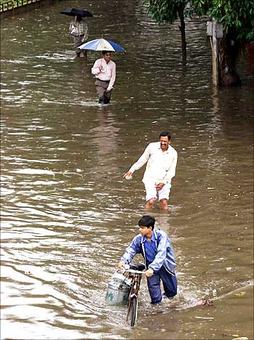
Two days ahead of the high tide warning, corporate houses here are busy drawing plans to meet any possible recurrence of the 26/7, 2005 deluge in the metropolis.

'What we are witnessing is not a freak incidence or a freak occurrence, but a new climate reality where warming oceans, monsoon variability and local geography are combining to produce extreme events.'

Bihar government has sounded alert in 28 flood-prone districts following a warning issued by Indian Meteorological Department in the wake of Cyclone Phailin that pounded Odisha and Andhra Pradesh.
'...they always address problems superficially, never tackling root causes.' 'Currently, the policy response will focus on immediate relief -- getting people to safety, providing facilities, clearing debris.' 'This is necessary, but once immediate relief operations end, everything returns to 'normal' without addressing underlying vulnerabilities.'

Year by year, our cities remain defeated in the face of weather conditions, costing us time, money, resources and often lives, observe Amit Kapoor and Bibek Debroy.

'China could intentionally release excess water.' 'The North East is already flood-prone during the monsoon, and even a controlled release from Chinese dams (during the monsoon) could worsen flooding.'
Heavy monsoon rains battered Karnataka's coastal belt for the third consecutive day on Monday, severely disrupting normal life in Dakshina Kannada district, prompting authorities to issue a red alert and deploy disaster response teams. A red alert indicates extremely heavy rainfall of over 20 cm in 24 hours, and will remain in force for the next five days, according to the India Meteorological Department (IMD). Several parts of Mangaluru city reported waterlogging and traffic snarls, while minor incidents of landslides were reported from hilly regions across the district. The district administration has directed schools and composite colleges to remain shut on 27 and 28 following the IMD issuing a red alert. Instructions were also issued to relocate residents living in vulnerable hillside and riverside areas to safer locations. The authorities have sought prompt action from the National Highways Authority of India (NHAI) following complaints of water intrusion in residential areas due to ongoing highway construction works.

Normally, the southwest monsoon makes its onset over Kerala by June 1 and covers the entire country by July 8. It starts retreating from northwest India around September 17 and withdraws completely by October 15.

Despite high exposure to floods, Assam, Bihar, Uttar Pradesh, Odisha, and Sikkim are the best performing states in terms of flood early warning systems (EWS), according to the report by independent policy research think tank The Council on Energy Environment and Water.
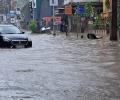
The IMD issued a "Nowcast" warning, forecasting thunderstorms accompanied by lightning and intense spells of rain with gusty winds reaching 50-60 kmph at isolated places in Mumbai in the next three to four hours.

Incessant rains since the past one week has triggered floods in several districts of Arunachal Pradesh with major rivers including Siang in high spate affecting several villages.

'The intensity and frequency of heatwaves will be much higher than in previous years over Punjab, Haryana, Rajasthan, Gujarat, Madhya Pradesh and Odisha.'
